Wednesday, May 25, 2022

Lisboa Story Centre


This week we took another journey through time.

Lisboa Story Centre is located in the very central Praça do Comércio. 

It was a unique experience because it wasn’t a normal museum, which I had expected it to be before going in: it really was a story. When you walk in, you are given an audio guide which explains the various sections of the exhibit and detects where you’re standing as you go through. Each section represents a different period or specific event, and is displayed either through video, art, or larger than life installations.

Lisboa Story Centre map


Lisboa Story Centre ship


The flying bird was invented by Father Bartolomeu de Gusmão – Portugal's Leonardo da Vinci – as a way to walk through the air. Even today it is said that it was a vehicle that really existed, others say that it was never more than a legend. Fact or fiction...we're talking about sometime between 1709 and 1720...some 45 years before the...yes, you've got it...great earthquake!!!


This beautiful capital city really does have an incredible story. We enjoyed learning more about how it came to be, what events took place here and how the city impacted people and places around the world.


Other activities this week included...

The new Downton Abbey movie is a "must see".

Feeding the missionaries. Taco Tuesday, no less. Sister Lecke is from Florida and Sister Grow is from Mountain Green. And guess who she had for her 3rd grade teacher...that's right...Mrs. Mac. Small world, as they say. 


Thursday, May 19, 2022

Maritime Museum

 The Maritime Museum or Navy Museum (Museu de Marinha), is one of the largest of its kind in Europe. It is dedicated to the history of Portuguese ships, shipbuilding, and everything else nautical. 


The entrance to the museum is in the same building as the Jeronimos Monastery. The location isn’t an accident. This was the chapel built by Henry the Navigator as a dedicated church for the voyagers to take mass before setting sail. Not accidentally, it’s just steps from the shoreline.


A statue of Prince Henry the Navigator welcomes visitors at the entrance, and behind him is a map of the world, showing the routes of the Portuguese explorers.


A surprising collection of more than 1700 pieces, including more than 400 naval models and 30 ships (some perfectly preserved), along with relics, maps, tools, and documents wait to be explored.

No maritime museum would be complete without a statue of Vasco da Gama!


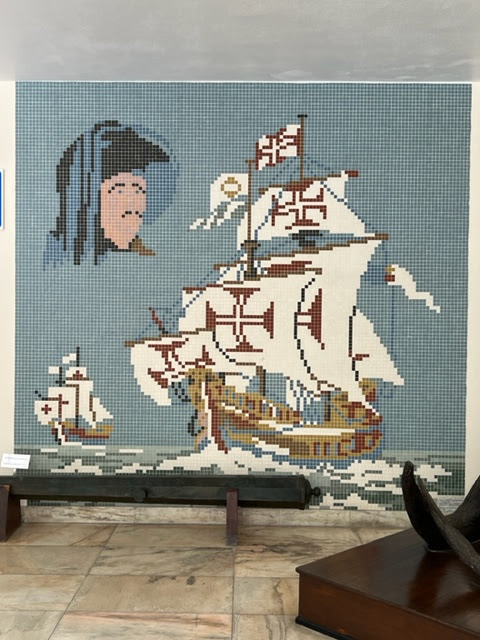
And nothing in Lisbon would be complete without a little tile picture!!

It was a fun day, for sure. We learned a lot about boats and exploring and the people who did such things. 
And it was made even better because, since we were in the neighborhood anyway,...


BTW
This just happens to be the puzzle we are working on at this time.
-The Tower of Belem-


Tuesday, May 10, 2022

Quake


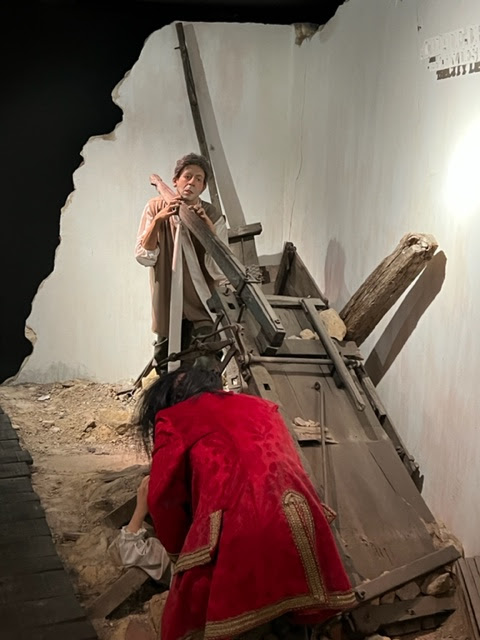
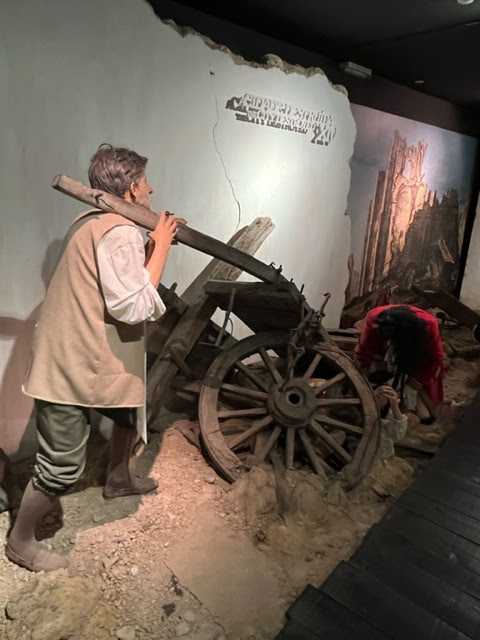
Today we stepped back 260 years in time to November 1, 1755, to relive the earthquake that destroyed the Portuguese capital, which at the time was the fourth largest city in the world.

The new QUAKE Lisbon Earthquake Experience just opened. It's an interactive museum where you can go to relive history.

 Lisbon was not only a city of 250,000 people but the capital of the Portuguese empire, which spread around the world. It was one of the most important cities in Europe. Although Portugal had been hit by quakes in the past it had been 200 years since the last major earthquake. The quake hit at 9:40 AM on All Souls Day. Many buildings collapsed, burying those inside and on the street outside. The quake triggered a tsunami, which arrived soon afterwards. As usual the first indication was that the water drew back from the land. Soon, however, the water came back with a wave estimated at 50 feet high crashing through the city. Ships, docks and buildings in the city were battered by the high seas. Thousands were swept away.


As if that wasn't enough, lamps and cooking fires upset in the tumult ignited and were impossible to control. It burned unchecked for three days, completing the destruction. In all more than 60,000 people died in the disaster in Lisbon alone. Thousands more died in other areas. The quake was felt throughout Western Europe and Northwestern Africa.

Many people thought that the quake was a result of an angry God responding to Lisbon's "sinful" ways. However, they were hard put to explain why one city was destroyed while others, just as "sinful" were spared. There were some, however, who studied the earthquake objectively, observing the direction of the shocks, sequence of events and other details to try to understand scientifically what was going on. In the end, the scope of the destruction was such that the country turned its attention to rebuilding Lisbon. Although nobody could replace what had been lost, the city rose again in beauty and grandeur.


We walked the streets of Lisbon before the quake.


We sat in the Church of São Nicolau, where we saw and felt what the earthquake must have been like, through video mapping and pews that moved as the earthquake increased in intensity and the building collapsed.
Then we walked through the streets of the lost city as the drama unfolded around us.


And finally, we got the opportunity to meet the heroes and villains from that time.

We had a great afternoon.

 Their experience 260 years ago went on for days, weeks, months, years, centuries!

Ours only lasted about 90 minutes.

We returned safe and sound!

Wednesday, May 4, 2022

Sintra National Palace (Palácio Nacional de Sintra)


Meanwhile, back in Sintra...

did I ever mention how charming this little town is?


(Portugal supports Ukraine.)

(The perfect size for a glass of fresh squeezed orange juice - for Don, anyway!)


The National Palace of Sintra is located in the center of town. It was inhabited for nearly eight centuries by the Portuguese monarchy and its court. It was much used, particularly during the Middle Ages, as a hunting retreat and as a refuge from outbreaks of disease in the capital, or as a summer resort, thanks to the town's more agreeable climate.


The two chimneys are one of the symbols of Sintra and are connected to the wide kitchen where the large feasts were cooked. These chimneys are unique in Europe.


The Sintra National Palace is just as interesting as Pena Palace though not nearly as crowded.

There's more to explore in Sintra.

We'll take you back another day for another visit to another magical spot. Until then...